
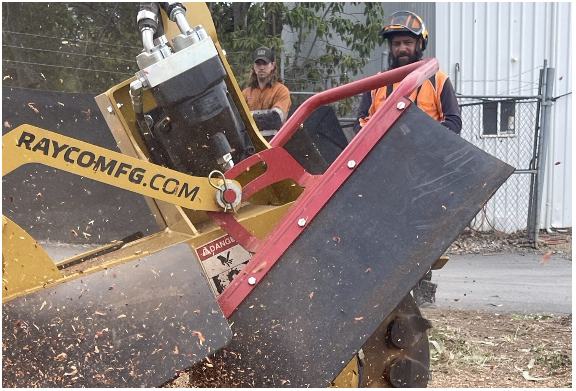
A stump grinder is a petrol or diesel machine with a spinning steel wheel on the front, edged with carbide teeth. The operator lowers the wheel onto the stump and sweeps it side to side, shaving the timber into chips a few millimetres at a time, then steps the wheel down and goes again until the stump is 200 to 300 mm below ground level. What’s left is a hole full of chips, not a stump.
People picture something that pulls the stump out. It doesn’t. It turns the stump into mulch where it sits, which is why there is no hole the size of a car and no truckload of root ball to cart away. Here is how the whole job runs, from the phone call to the raked-off hole, using the two machines we run every week.
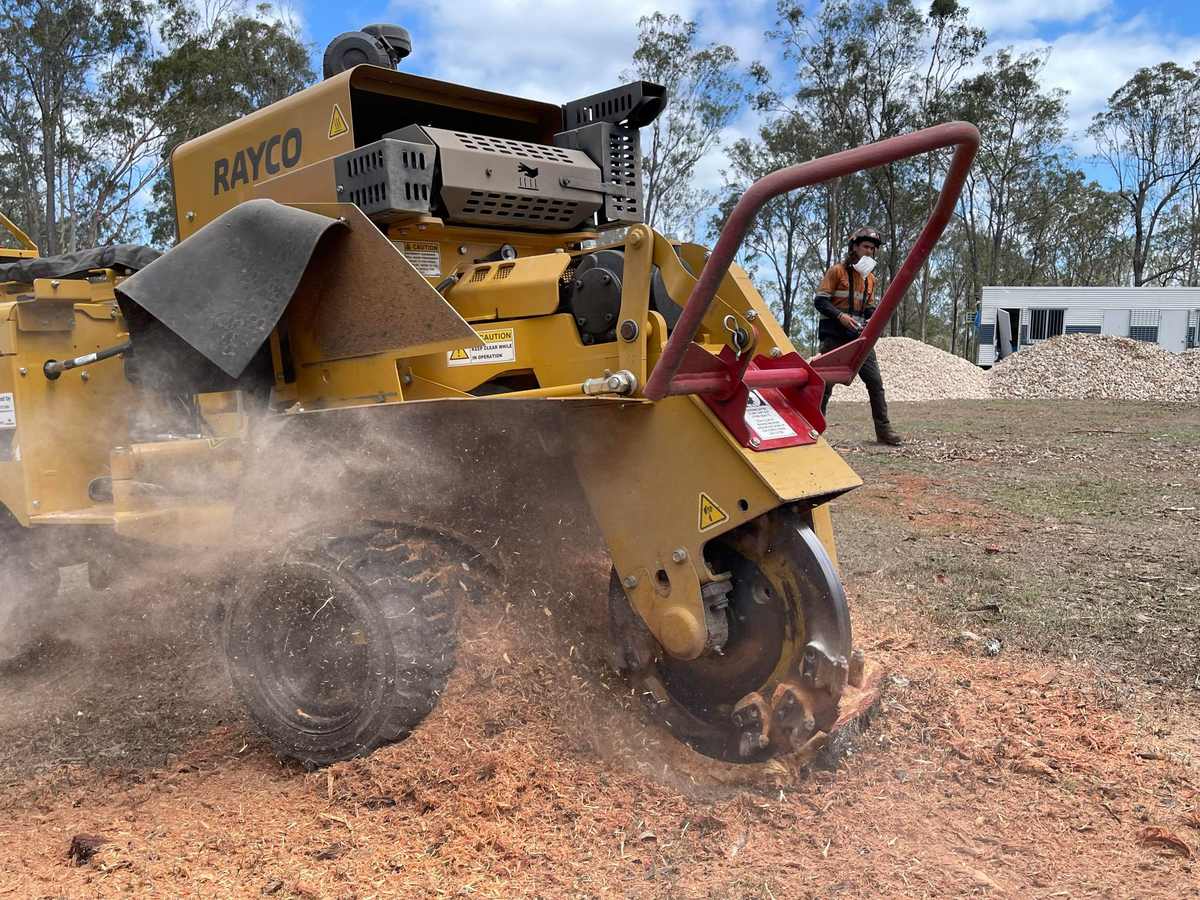
What are the parts of a stump grinder?
Four things matter. The cutter wheel, a steel disc 400 to 600 mm across with 20 to 40 replaceable carbide teeth bolted around the rim. The engine, 25 to 80 horsepower on the machines we use. The boom that raises, lowers and swings the wheel. And the drive, either wheels or rubber tracks, which decides where the machine can get to. The teeth are the consumable; we check and rotate them before every job because blunt teeth burn the timber instead of cutting it and double the time on a hardwood stump.
Which machines do you use in Brisbane?
| Machine | Gets through | Best for |
|---|---|---|
| Compact self-propelled grinder | A standard side gate, steps and tight gaps beside the house | Backyards, courtyards, stumps beside fences and pipes, new estates with tight access |
| Rayco RG80 wheeled grinder | At least 900 mm of clear access (a driveway or double gate) | Big gum and camphor laurel stumps, acreage, multi-stump jobs, commercial yards |
The compact machine is the one most Brisbane homes need. It will grind a typical backyard stump in under an hour and it fits through a side gate. The RG80 is what we bring when the stump is a metre across, or there are 15 of them on an acreage block in Karalee or Jimboomba, because it chews through in a fraction of the time.
What happens on the day, step by step?
- Quote from a photo. Most residential stumps are priced from a photo you text us, with the suburb and a note about access. No site visit needed.
- Before You Dig. If the stump is near a boundary, a driveway or anywhere services might run, we check Before You Dig Australia and look for water meters, irrigation and NBN pits. Hitting a pipe is the one mistake you can’t undo.
- Clear the stump. Rocks, fence wire and old bricks around the base get raked off. Rocks are what break teeth.
- Grind the top down. The wheel starts at the top edge and sweeps across, taking 20 to 30 mm a pass. A 400 mm gum stump is 15 to 20 minutes of this.
- Go below ground. We keep stepping down to 200 to 300 mm below the surface, deeper if you’re planting a new tree or putting a slab over it.
- Chase the roots. The big surface roots that run out from the stump get followed and ground for a metre or so, because they’re the ones that lift turf and foul a mower.
- Rake and backfill. The chips come out of the hole, the hole is backfilled with the soil that was around it (or left for you to top with soil and turf), and the lawn is raked flat.
Noise: it is a loud machine for the 20 to 60 minutes it runs. We wear ear and eye protection and keep the guard down. You don’t need to be home, but tell the neighbours if the stump is on the fence line.
How deep does a stump grinder go?
Standard is 200 to 300 mm below ground, which is enough to turf over, plant a garden bed or lay pavers. If you’re going to plant another tree in the same spot, we go deeper and take more of the root mass so the new roots have room. If a slab, pool or retaining wall is going over it, that is usually an excavator job to pull the whole root plate, and Dynamic Earth Solutions handles the excavation side of that.
If concrete is going over the stump, depth and backfill change: see stump grinding before a slab, driveway or retaining wall.
Can I hire a stump grinder and do it myself?
You can. The hire-yard machines are small and slow, and a 300 mm hardwood stump will take a first-timer most of a Saturday, plus the trailer, plus the deposit, plus the teeth you’ll blunt on the first rock. The machine throws chips and stones hard, and the wheel doesn’t care what it hits. For one small stump with easy access it can be worth it. For a big stump, a stump near services, or more than two stumps, a contractor is cheaper by the time you add everything up: we start from $250 for a typical domestic stump, with a multi-stump discount of up to 50 per cent. The cost page has the detail.
We grind stumps across the Brisbane southside, the northside and Ipswich. Text a photo to 0449 003 606 or use the quote form.
Frequently asked questions
How does a stump grinder work?
A spinning steel wheel with carbide teeth is lowered onto the stump and swept side to side, shaving the timber into chips 20 to 30 mm at a pass. The operator steps the wheel down until the stump is 200 to 300 mm below ground, then the chips are raked out and the hole backfilled.
How long does it take to grind a stump?
A typical 300 to 400 mm domestic stump takes 15 to 30 minutes of grinding, plus set-up and clean-up. A metre-wide gum stump can take an hour or more. We usually allow an hour on site for one stump and less per stump when there are several.
Does a stump grinder remove the roots?
It grinds the stump and the large surface roots near it. The smaller roots further out stay in the ground and break down over a year or two. If every root must go, for example under a slab, that is an excavator job.
Is it worth hiring a stump grinder myself?
For one small stump with easy access, maybe. For big stumps, stumps near pipes or fences, or more than two stumps, a contractor is usually cheaper and much faster once you count hire, trailer, teeth and your day.
Can a stump grinder fit through a side gate?
Our compact self-propelled grinder fits through a standard side gate and handles steps. The larger Rayco needs at least 900 mm of clear access, so a driveway or double gate.