
Storm season in Brisbane runs from about October through to March, with the worst of the afternoon cells usually landing between November and January. The job before it starts is simple: get dead wood and hanging limbs out of the trees, get old rotting stumps out of the ground, and know who you are ringing when something comes down. Do it in October while the ground is still dry and the crews are not flat out.
Every year it is the same pattern. A hot, sticky week, a black line of cloud over Ipswich about 3 pm, and by 5 pm the phone is going with trees on sheds and root plates standing up out of lawns. Most of those jobs were avoidable. Here is what we tell people who ask how to get ready for storm season in Brisbane, in the order we would do it ourselves.
When does storm season in Brisbane start and finish?
The Bureau treats the severe thunderstorm season in South East Queensland as roughly September or October to March. Cyclone season is officially 1 November to 30 April. Brisbane itself rarely takes a direct hit from a cyclone, but ex-tropical systems and east coast lows do reach us, and in March 2025 the city got a long look at what a slow-moving one does to waterlogged ground and shallow-rooted trees.
The practical point is that the window to prepare is now, not December. Once the first big storm has been through, every arborist and stump grinder in the city is booked out on make-safes and clean-ups, and the small preventative jobs go to the back of the queue. Keep the BOM Queensland warnings page bookmarked and have a household plan written down. The state’s Get Ready Queensland site has a free template that takes ten minutes to fill in.
Why do old stumps matter in a storm?
Because a stump is not just sitting there. Under the ground, the roots are rotting, and rotting roots turn into channels. Water follows them. After a week of rain the soil around an old stump is softer and wetter than the lawn next to it, which is exactly where you do not want a leaning fence post, a retaining wall footing or the roots of the next tree along.
The bigger problem is a stump with a lot of trunk left on it, or a tree that has been lopped back to a pole and left. When the root plate has started to decay and the ground is saturated, a strong gust is enough to lever the whole thing over. We wrote about the detail of this in our post on why old stumps are a wet-weather hazard, so we will not repeat it all here. The short version is: if the stump is soft, hollow or has fungus on it, it is past its use-by date.
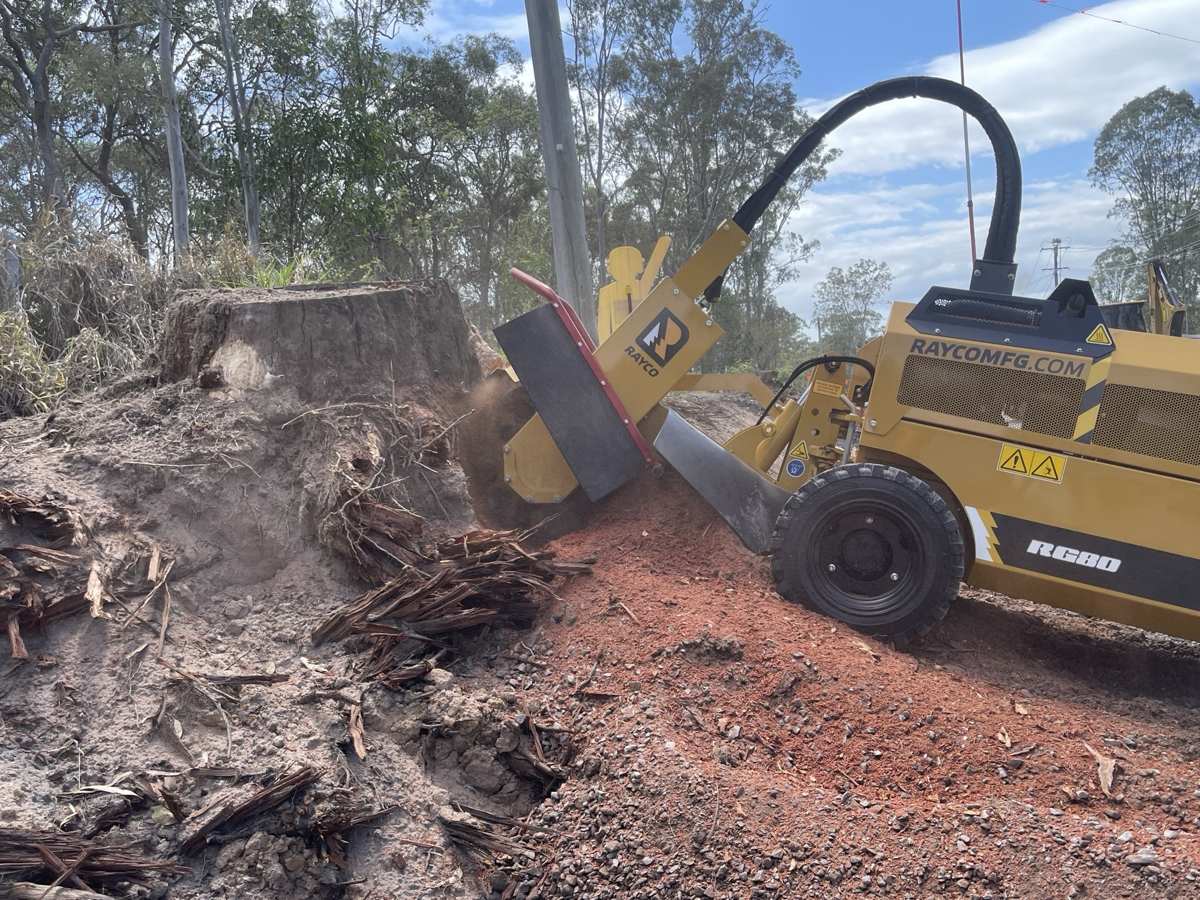
Grinding it now also means we can get the machine to it. A tracked grinder on dry ground leaves nothing behind. The same machine on a soaked lawn in January leaves ruts you will be looking at until Easter.
What should I check on my trees before November?
You do not need to be an arborist to spot the obvious. Walk the yard after work and look for these:
| What you see | What it means | Do this |
|---|---|---|
| Dead branches with no leaves, bark peeling | Dead wood is the first thing a gust strips out | Get it pruned out before the season |
| A limb hanging or cracked at the union | Already failed, just has not landed yet | Keep people out from under it, book it in now |
| Mushrooms or conks at the base, soft bark | Root or butt rot | Have it assessed; this is the one that falls over whole |
| Soil lifting or cracking on one side of the trunk | The root plate is moving | Treat it as urgent |
| Tall tree, shallow roots, close to the house | Norfolk pines, cocos palms, some gums | Get a professional opinion on removal or reduction |
| Old stump, soft or hollow | Rotting roots, wet soil, lifting risk | Grind it out, backfill, turf it |
Tree work above the ground is a climbing job and that is not what we do. Pruning, dead-wooding, reductions and removals are handled by the arborists in our group, and their guide to getting trees storm-ready goes into how they assess a tree and what insurers expect. What we do is everything from ground level down. One phone call covers both.
A good example came through this month from Brassall in Ipswich: a Norfolk Island pine around 33 metres tall, a metre off the back fence, and the owner wanted it gone before the storms rather than after. That is the right instinct. Shallow-rooted tall trees on the fence line are the ones that end up on the neighbour’s roof.
What jobs should be done before storm season?
In the order we would do them:
- Dead wood and hangers out. This is the cheapest insurance there is and it is the work most people skip.
- Old stumps ground out. Anything soft, hollow or within reach of a fence, slab or retaining wall. From $110 for a small one and around $220 for a typical domestic stump, with a multi-stump discount of up to 50 per cent if you have a few. Full pricing is on our stump grinding cost page.
- Backfill and level. Grindings settle. Rake them out, top the hole with soil, and it will take turf before the rain.
- Clear the gutters and downpipes. Not our trade, but a blocked gutter plus a limb on the roof is how water ends up in the ceiling.
- Tie down or put away anything light. Trampolines fly. Every year.
- Photograph the yard. Two minutes on your phone now gives your insurer a before picture if something does come down.
Two stumps in Forest Lake last month were a textbook pre-season job: the bigger one around 35 to 40 centimetres across, easy access off the driveway, both ground below ground level with the surface roots taken out so the owner could level and turf it. In and out in a morning, and nothing left in the ground to rot through summer. We do a lot of that work across the southside from Forest Lake and Sunnybank to Browns Plains, the northside through Chermside and North Lakes, and Ipswich.
Does Brisbane get cyclones or hurricanes?
Same thing, different ocean. What Americans call a hurricane we call a tropical cyclone, and Brisbane is on the southern edge of where they travel. Direct hits are rare. What we do get is the leftovers: a system that has weakened to a tropical low but still dumps days of rain and brings strong winds with it. For trees and stumps that is the worst combination, because the ground is saturated first and the wind arrives second. A tree that would stand up to a dry 80 km/h gust will go over in a 60 km/h gust when its roots are sitting in mud.
The ordinary summer thunderstorm is still the bigger risk for most Brisbane yards. Hail, a downburst and a few minutes of wind you cannot stand up in, then sunshine. That is what takes the limbs off and lifts the rotten stumps.
What do I do when a tree comes down?
If anyone is hurt, ring 000. If power lines are involved, ring Energex on 13 19 62 and stay well back. If the roof is open and rain is coming in, the SES on 132 500 do emergency tarping. For a tree on the house, shed, car or fence, ring us and we will arrange the make-safe and the removal, and the stump or root plate gets ground out at the end. We wrote up the whole process in what happens when you call for emergency tree removal, including the photos your insurer will want.
The honest summary is that most of the storm work we do in January could have been a quiet half-day job in October. Walk the yard this week. If you find a soft stump or a tree you are not sure about, text a couple of photos to 0449 003 606 or use the quote form and we will tell you straight whether it can wait.
Frequently asked questions
When is storm season in Brisbane in 2026?
The severe thunderstorm season in South East Queensland runs from about October to March, with the most active period usually November to January. The official cyclone season is 1 November to 30 April. The best time to prepare trees and grind old stumps is September and October, while the ground is dry and crews are not booked out on storm clean-ups.
Does Brisbane have a cyclone season?
Queensland's cyclone season is 1 November to 30 April. Brisbane rarely takes a direct hit, but weakened tropical systems and east coast lows do reach the city and bring days of heavy rain followed by strong wind. That combination of saturated soil and wind is what brings down trees with shallow or rotting roots.
Is there a hurricane season in Brisbane?
A hurricane and a tropical cyclone are the same type of storm with different names. In Australia they are called cyclones, and the season runs from 1 November to 30 April. For Brisbane the more common risk is the summer afternoon thunderstorm, which brings hail, downbursts and short bursts of very strong wind.
What storm season jobs should be done around the house in Brisbane?
Prune dead wood and hanging limbs, have any tree with fungus at the base or lifting soil assessed, grind out old or soft stumps and backfill the hole, clear gutters and downpipes, put away or tie down light items like trampolines, and photograph the yard so your insurer has a before picture.
Why should old stumps be ground out before storm season?
Rotting roots under an old stump channel water into the soil around it, so after heavy rain that patch is softer than the rest of the yard. A stump with trunk left on it, or a lopped tree left as a pole, can lever over in strong wind once the root plate decays. Grinding it out and backfilling removes the problem and is easier on dry ground.
How much does it cost to grind a stump before storm season?
Stump grinding with All Sites starts from $110 for a small stump and is around $220 for a typical domestic stump, with a multi-stump discount of up to 50 per cent. Price depends on diameter, access and how deep you need it ground. Text a photo for a quote.