
If a slab, driveway, path or retaining wall is going where a tree used to be, the stump has to go further down than a lawn job and the roots under the footprint have to go with it. For a path, pavers or a lightly loaded driveway, grinding 300 to 400 mm below finished level and chasing the main roots is enough. For a house slab, a pool or a retaining wall footing, the engineer will usually want the whole root plate out, and that is an excavator job, not a grinder job. Ask before you book, and we will tell you which one you need.
We do a lot of this work for owner-builders, landscapers and small civil crews around Brisbane and Ipswich, and the same questions come up every time: how deep, what about the roots, what goes back in the hole, and who signs off. This is the plain version.
How deep does a stump need to be ground before concrete?
Measure from the finished level, not the current ground. A driveway is usually 100 to 150 mm of concrete on 100 mm or so of compacted base, so the top of the stump needs to be at least 300 mm below where the new surface will sit, and we go to 400 mm to leave room for the base to compact properly. For pavers and paths, 250 to 300 mm below finished level is plenty. For a lawn or garden bed we would stop at 200 to 300 mm; concrete needs the extra because any timber left under the base keeps rotting, and rotting timber turns into a void.
| What’s going over it | Grind depth below finished level | Roots | Who decides |
|---|---|---|---|
| Turf, garden bed | 200 to 300 mm | Surface roots only | You |
| Path, pavers, synthetic turf | 250 to 300 mm | Chase roots under the footprint | You or the landscaper |
| Driveway, shed slab, carport | 300 to 400 mm | Chase all roots under the footprint, 1 m past the edge | Concreter or builder |
| House slab, pool, retaining wall footing | Usually full root plate removal | Everything under and beside the footing | Engineer or certifier |
Why do the roots matter more than the stump?
Because the stump is the bit you can see. A mature gum has lateral roots the thickness of your arm running a metre or more out from the trunk, 100 to 300 mm down, which is exactly the zone a driveway base sits in. Leave them and two things happen. First, they rot, and the base settles into the gap, and the slab cracks along a line that tells you exactly where the root was. Second, if the tree was removed recently, some species keep pushing suckers from live roots and they will find the joint in the concrete. So on a slab or driveway job we grind the stump, then follow each main root out with the cutter wheel until it is under 50 mm thick, usually to about a metre past the edge of the new concrete.
Rule of thumb for a retaining wall: if the wall footing or the drainage line crosses where the roots were, the roots have to come out, not be ground around. That is where it stops being our job and becomes an excavator job.
What goes back in the hole?
Not the grindings. This is the one most people get wrong. Stump grindings are wood chips mixed with soil; under a lawn they are fine, under concrete they are a sponge that settles. For anything that will carry a load, we rake every chip out of the hole and leave it empty for your concreter or landscaper to backfill with road base or crusher dust in compacted layers. If you want us to backfill, we can bring the base material and do it, but tell us at the quote stage so it is priced in. For a turf or garden job we do the opposite: chips back in, heaped, settle for a few weeks, then top with soil.
When is it an excavator job instead?
Three situations. One, the engineer or certifier wants the root plate gone (house slab, pool shell, wall footing); a grinder cannot pull a root plate, it can only turn it into chips in place. Two, there are more than about 15 stumps on a block being cleared for a build; past that count an excavator with a ripper is faster and cheaper than grinding each one. Three, the stump is sitting in the line of a new sewer or stormwater trench, so it is coming out with the trench anyway. In all three, Dynamic Earth Solutions handles the excavation; same group, same phone call, and we still grind anything outside the footprint so you are not paying excavator rates for a stump in the back corner.
What does a pre-slab stump job look like in practice?
A recent one in Camira, on the Ipswich side of Springfield: the owner’s civil works were starting the following Monday and there were three small stumps in the area to be worked, plus a tree and some shrubs to come out. The brief was simple: ground down so the contractor could backfill and grass over. We took the three stumps below ground level, chased the roots that ran toward the work area, raked the chips out and left the holes ready for the civil crew. Quoted from the photos, done in a morning, no site visit needed before the day.
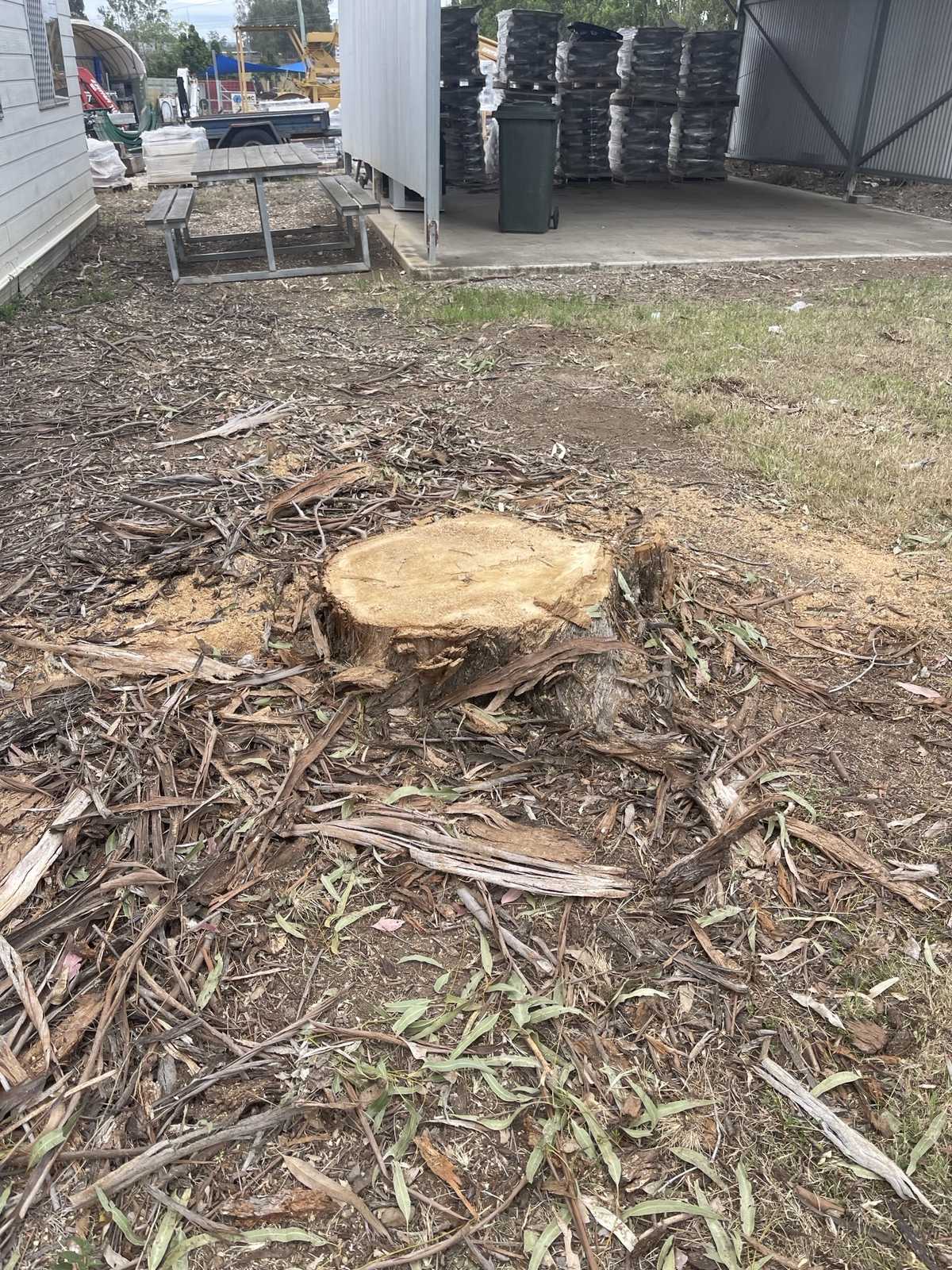
On commercial yards it is the same job with a bigger machine: a stump cut flush beside a site office (the one in the photo) ground out with the Rayco so a hardstand could go in, and the chips removed rather than left, because nothing organic goes under a compacted pad.
What do you need from me before you quote?
- What’s going over it. Lawn, pavers, driveway, slab or wall. This decides the depth and whether it is a grinder or an excavator.
- The finished level. If the new surface will be higher or lower than the current ground, say so.
- Services. We check Before You Dig Australia for anything near a boundary, and you tell us about irrigation, drainage and the old stormwater line nobody drew on a plan.
- Access. Side gate, driveway, or open block. The big machine needs 900 mm clear.
- Photos. One of each stump with something for scale, and one showing how we get there.
Pricing is the same structure as any other stump: from $110 for a small one, about $220 for a typical domestic stump, deeper grinding and root chasing priced on top, and a multi-stump discount of up to 50 per cent when a block has several. The cost page explains what moves the number. We do this work across the southside, Ipswich and the northside, and our site preparation post covers the landscaping side.
Building over an old stump? Text a photo and what’s going there to 0449 003 606, or use the quote form, and we will tell you grinder or excavator before you spend a cent.
Frequently asked questions
How deep should a stump be ground before pouring a driveway?
At least 300 mm below the finished driveway level, and we go to 400 mm so the base can be compacted properly. Measure from the new surface, not the current ground. Roots under the footprint are chased out to about a metre past the edge.
Can you pour a concrete slab over a ground stump?
Over a path, pavers or a lightly loaded driveway, yes, if it is ground deep enough, the roots are chased and the hole is backfilled with compacted base, not chips. For a house slab, pool or retaining wall footing the engineer will usually require the whole root plate removed with an excavator.
Should the stump grindings be used as backfill under concrete?
No. Grindings are wood chips and soil; they rot and settle, and the slab cracks above the void. Rake them out and backfill with road base or crusher dust in compacted layers. Under a lawn, grindings are fine.
Do tree roots need to be removed before a retaining wall?
If the footing or the drainage line crosses where the roots are, yes, and that is an excavator job rather than a grinding job. Roots outside the footing line can be ground.
When is an excavator better than a stump grinder?
When the root plate must be removed for an engineered slab or footing, when a block has more than about 15 stumps to clear, or when the stump sits in the line of a trench that is being dug anyway.
How much does stump grinding before a slab cost?
From $110 for a small stump and about $220 for a typical domestic stump, with deeper grinding and root chasing priced on top and a multi-stump discount of up to 50 per cent. Send photos and say what is going over it for a same-day quote.