
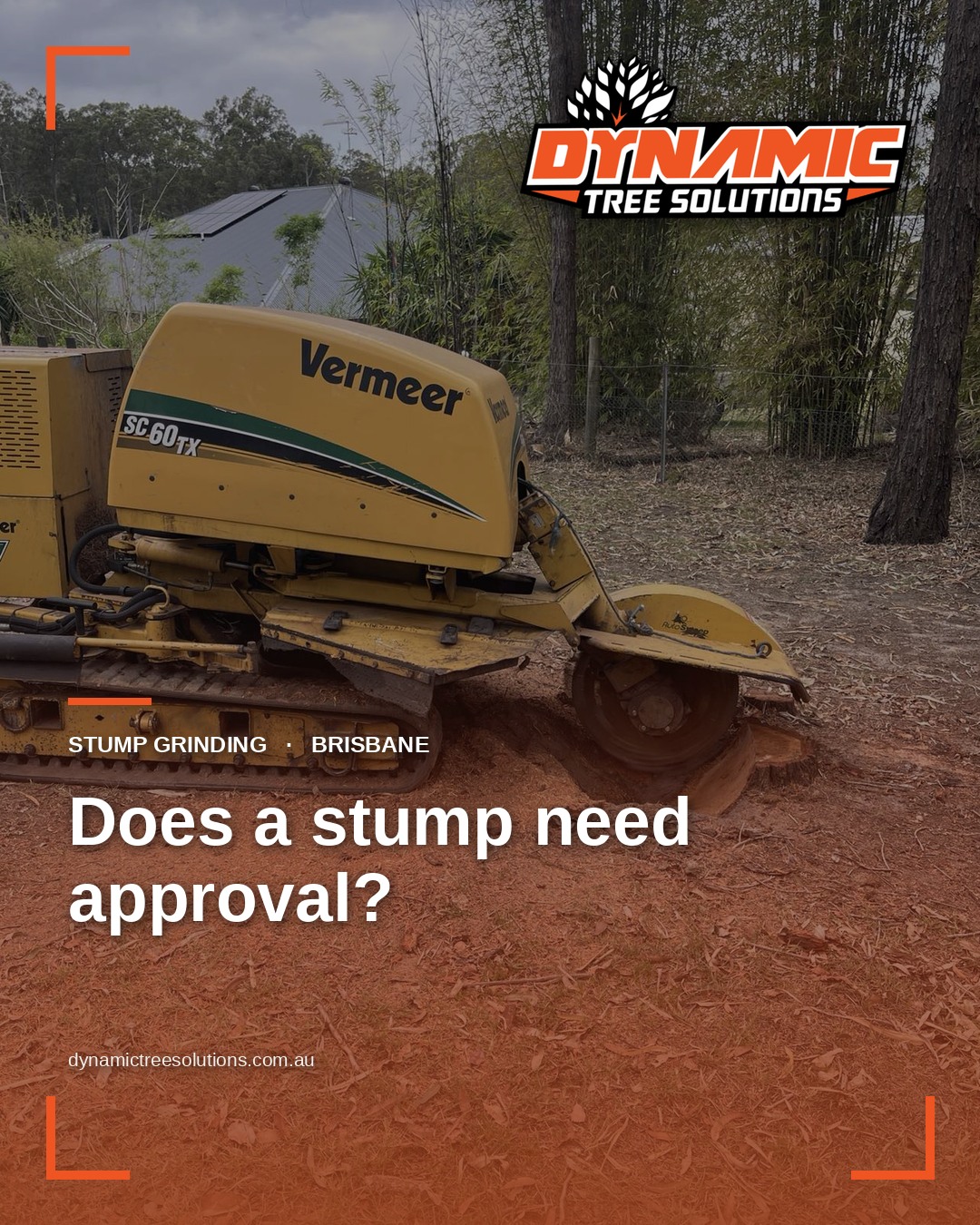
People ring us about the stump long after the tree is gone. The removal happened months ago, the grass has grown up around the stump, and now there is a shed going in or a fence line to run straight through it. The first question is nearly always the same: do I need council approval to grind it out?
For most Brisbane backyards, no. But “most” is not “all”, and the exceptions are worth ten minutes of your time before you book anyone in.
Stumps versus living trees under Brisbane’s local law
Brisbane’s vegetation rules are built around living trees. The Natural Assets Local Law is concerned with vegetation on council’s protected vegetation map — the canopy, the habitat, the thing that is alive and doing a job in the landscape.
A stump that has been cut flush and is dead is a different proposition to a standing tree. Once the tree is gone, the thing the law was protecting is already gone with it. Grinding the remainder out of the ground is, in the ordinary suburban case, site cleanup rather than vegetation removal.
Two things change that. One is a stump that is not actually dead — a gum or a camphor laurel throwing shoots off the collar is still a living plant, and if that lot is mapped, you are back to asking the question properly. The other is where the stump sits. Inside a waterway corridor or a mapped environmental area, the ground itself is the sensitive part, and machinery working the soil can matter as much as the plant did.
If you are not sure which of those you have, look the address up on council’s protected vegetation map first. Dynamic Tree Solutions has the full plain-English rundown on Brisbane City Council tree regulations, and it is the right thing to read before you pick up the phone.
When the tree was protected: what happens to the stump
Here is the case that trips people up. The tree was mapped, a permit was issued, the tree came down legally — and the permit said nothing about the stump.
Read the approval before the grinder turns up. Some approvals carry conditions that outlive the tree: a replacement planting in the same spot, protection of a root zone belonging to a neighbouring tree, or a restriction on ground disturbance in a mapped area. Grinding out a stump in a hurry can quietly undo a condition someone agreed to in writing.
It works the other way too. If the removal was done under one of the exemptions rather than a permit — the tree was inside 3 m of the house, the trunk was under the diameter threshold, or it was an immediate hazard — there is usually nothing hanging over the stump at all. The colleagues who send us most of our work have set out those cases in full in their guide to Brisbane council tree removal permit exemptions, and the five situations in it cover the majority of suburban removals.
Either way, keep the paperwork. A copy of the permit or a photo of the tree before it came down costs nothing to file and answers every question later.
Sorting the paperwork first also makes the job easier to price. See what stump grinding costs in Brisbane before you book.
Roots, footpaths and council land
The boundary is where jobs get complicated. A stump sitting in your yard is yours. A stump on the nature strip is not — verge trees and their stumps belong to council, and grinding one out without asking is a conversation nobody wants to have.
Roots are the grey area. A big fig or gum sends structural roots well past the trunk, often under the footpath, the driveway crossover or the neighbour’s fence line. Chasing those roots out is no longer a stump grind, it is excavation, and once you are working in the road reserve or under a crossover there may be other approvals in play that have nothing to do with vegetation law.
There are services down there as well. Water, gas, comms and power all run shallower than people assume in older Brisbane suburbs. Any grind near a boundary starts with locating services, not with dropping the wheel in and hoping.
Getting the stump out cleanly after an approved removal
Once you know where you stand, the grind itself is straightforward. What you are deciding is how deep and how wide.
Turf only needs about 150 to 200 mm below grade, enough for topsoil and root growth. A garden bed wants more. Anything structural — a slab, a shed pad, footings or a retaining wall — needs the stump and the major laterals out properly, because timber left in the ground rots, settles and takes the surface with it. Termites are the other reason: a buried stump is harbourage, and Brisbane has plenty of termites looking for exactly that.
Tell whoever is grinding it what is going in afterwards. “Grind the stump” and “prepare this spot for a shed” are two different jobs, and the difference is decided before the machine arrives, not after.
Not sure whether your stump needs approval or just a machine? Send us the address and a photo and we will tell you straight, and book it in if it is clear.
Frequently asked questions
Do I need council approval to grind a stump in Brisbane?
In most suburban cases, no. Brisbane's vegetation rules are built around living trees, so a dead stump on an unmapped lot is generally site cleanup. A stump that is reshooting, or one inside a mapped environmental or waterway area, needs checking first.
Can I grind a stump on the nature strip?
No. Verge and street trees and their stumps belong to council, not the adjoining owner. Contact council before anyone works on one.
How deep should a stump be ground out?
About 150 to 200 mm below grade is enough for turf. A garden bed wants more, and anything structural such as a shed pad, slab or retaining wall needs the stump and major lateral roots removed properly so the ground does not settle later.