
A tree fell on the fence: first make it safe, then photograph everything, then ring your insurer before anyone cuts anything. In Queensland the two neighbours usually share the cost of a dividing fence, but if the tree belonged to one of you and it was a known risk, that owner can end up wearing the lot. Storm damage with no fault on either side is normally a fifty-fifty repair, and most home building policies cover their share.
We get the phone call every storm season, usually between about 5 pm and dark. The gum has gone over, the Colorbond is folded in half, the neighbour is standing on the other side of it, and the question is never really about the tree. It is “who pays for this?” Here is the straight answer from a crew that does the make-safe, the clean-up and the stump afterwards.
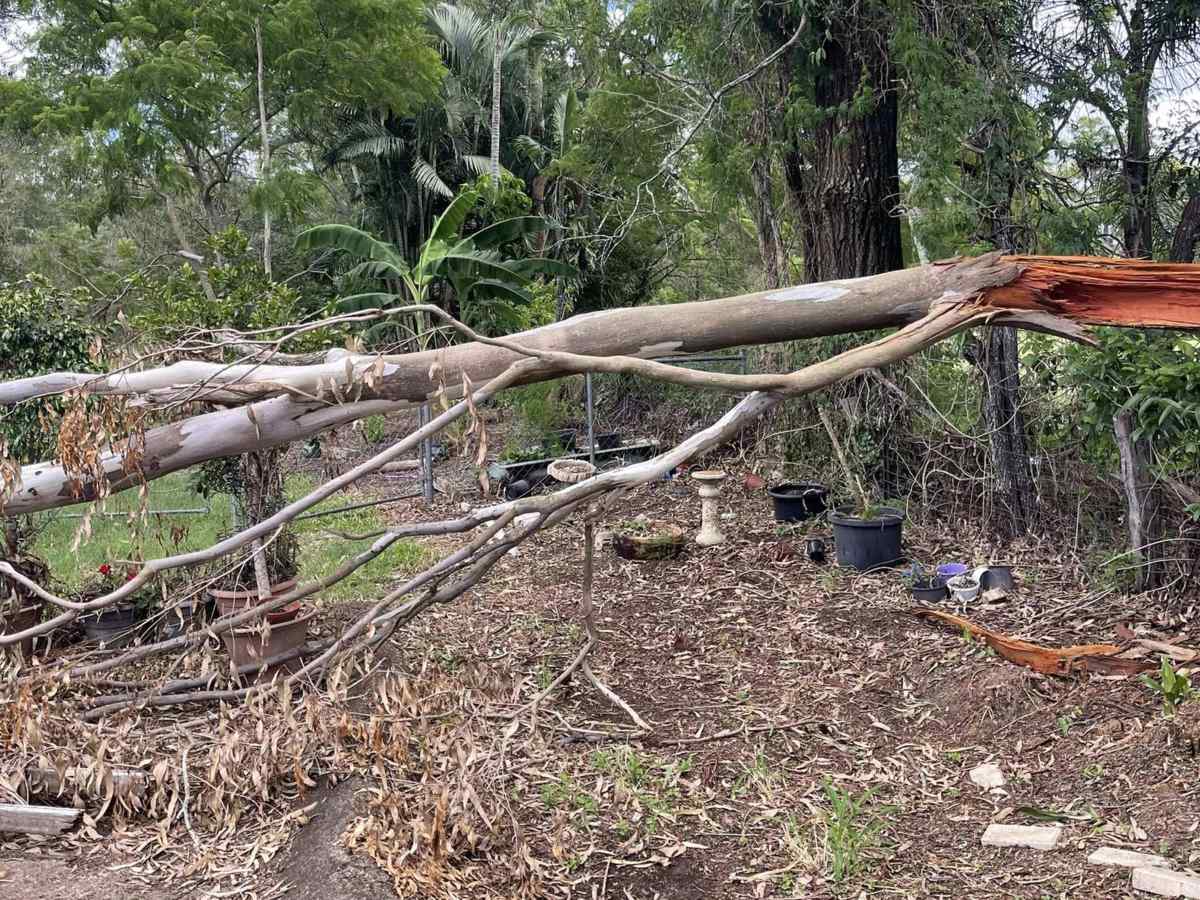
Tree fell on fence: who pays in Queensland?
Queensland runs on the Neighbourhood Disputes (Dividing Fences and Trees) Act 2011, and the Queensland Government’s plain-English page on your responsibility as a fence owner puts it simply: neighbours usually contribute equally to building and maintaining a dividing fence. The law only asks for a “sufficient” fence, which in the suburbs means something between half a metre and 1.8 metres high made of timber, metal, chain wire, brick or the like. If one of you wants the fancy version, that person pays the difference.
Trees change the picture. The same site explains your responsibilities as a tree-keeper: the registered owner of the land the tree grows on is responsible for the whole tree, roots included, and can be liable for damage it causes next door. The Act’s definition of a tree is wide enough to include a bare trunk and “a stump rooted in the land including a dead tree”. So the dead ironbark you have been meaning to deal with is still your tree when it lands on the fence.
| What happened | Who usually pays for the fence |
|---|---|
| Healthy tree, big storm, nobody could have seen it coming | Shared equally. Both insurers are often involved. |
| A tree the owner knew was dead, split or leaning, and did nothing about | The tree-keeper, if the neighbour can show the risk was known. |
| Tree on the boundary line itself | Both owners are tree-keepers; shared. |
| A contractor, or anyone a neighbour let onto their land, damaged the fence | That neighbour must restore the fence to a reasonable standard. |
If you cannot agree, mediation is free, and the Queensland Civil and Administrative Tribunal handles tree and fence disputes without lawyers. Most people never get that far. A photo, a quote and a civil conversation over the wreckage sorts it nine times out of ten.
Does home insurance cover a tree falling on the fence?
Usually, yes, for storm damage, and this is the bit people get wrong in the first hour. Most Queensland home building policies cover storm damage to fences, and most will also pay to remove the fallen tree where it has damaged something insured, like the fence, the shed or the house. Many policies pay half of a dividing fence and expect the neighbour’s policy to pick up the other half, which is why both of you should lodge a claim. Some policies cap fence cover or exclude fences in a named cyclone, so read your own PDS rather than taking our word for it.
What insurers hate is a job done before they have seen it. So: photos, phone call, make-safe, then the clean-up and the new fence. Take wide shots of the tree, the fence and both yards, and a close-up of the broken base. If it was rotten inside, that photo matters, and the neighbour should get the same photos the same day.
What should I do first when a tree falls on the fence?
Four things, in this order.
One, powerlines. If the tree is on or near wires, or the fence has a live wire tangled in it, stay away and ring Energex on 13 19 62. Nobody from our crew or anyone else’s touches a tree that is in contact with the lines until the network has made it dead.
Two, the house. If the tree is on a roof, through a window or blocking the only way out, the SES on 132 500 is the number for a storm make-safe. If it is only the fence and the yard, you do not need the SES; you need a tree crew and some patience.
Three, the fence line itself. A fence with a tree on it is under load. Colorbond panels spring when the weight comes off and a flattened timber fence can have a rail waiting to swing, so keep kids, dogs and the neighbour’s chooks away until the tree is off. That is the job we are called for most after a storm: tree off the fence in pieces, cut to a size the chipper or tipper can take, fence repair left to a fencer.
Four, the paperwork. Photos to the insurer, a note to the neighbour, and a written make-safe report from whoever does the cutting; insurers’ builders ask us for exactly that, plus a safe work method statement and an itemised invoice. For the long version of what happens when you ring, our emergency tree services page walks through it.
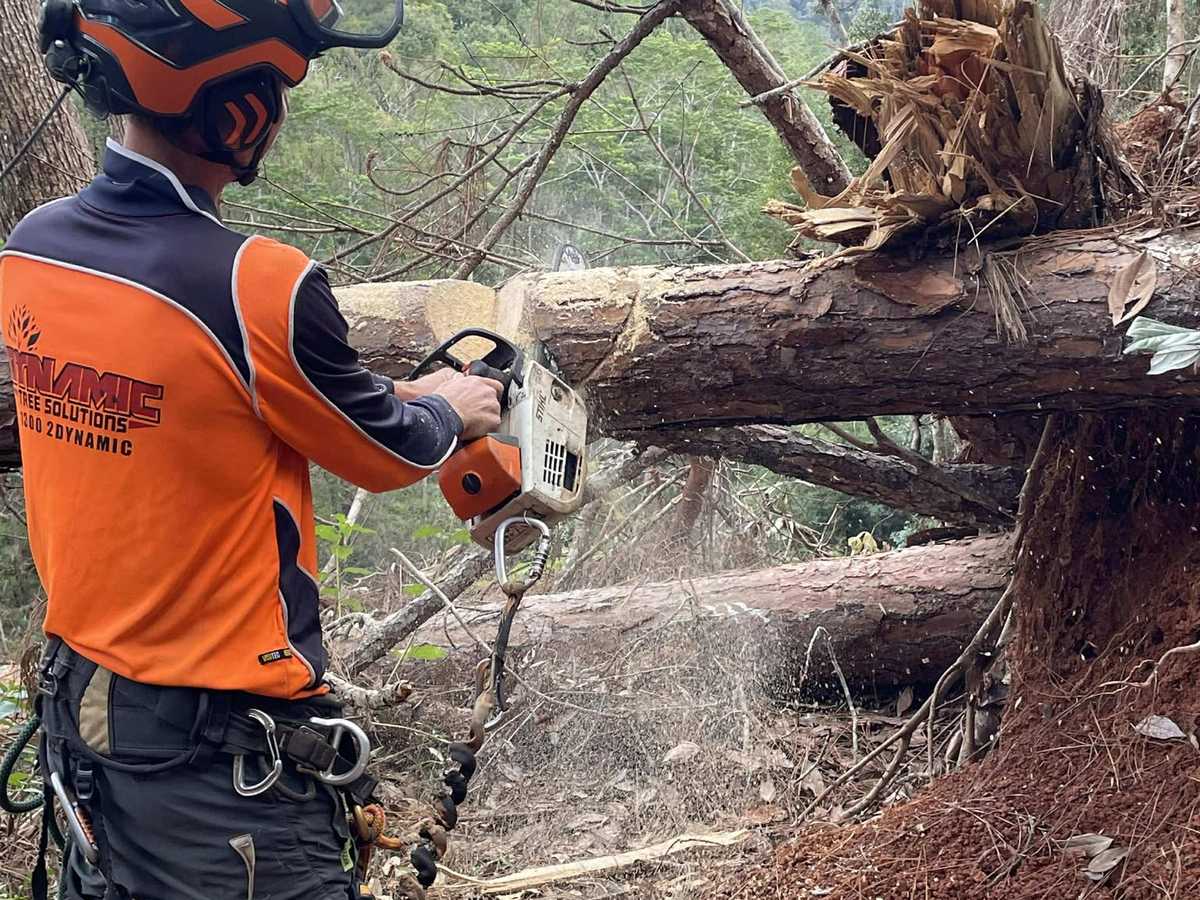
What does a make-safe actually involve?
A job at Warner, on Brisbane’s northside, is a fair example. A large gum uprooted in a storm, came down across the back steps and a chicken-wire boundary fence, and finished up in the neighbour’s chook pen. The insurer’s storm-damage builder sent us. The crew went in through the neighbour’s yard with their OK, took the crown off in sections so the wire fence did not get dragged any further, cut the trunk into rounds, grabbed everything out with the six-tonne excavator, and ground the root plate so the fencer could set a new post where the old one used to be. One visit, a report for the insurer, and the neighbour’s chooks were back behind wire that week.
A storm make-safe is not a tidy removal. It is a tree under tension, in the dark half the time, with a fence and someone else’s property under it. The climbing and rigging is done by the arborist crew we trade under, Dynamic Tree Solutions, and their guide to trimming trees along a fence line before they become a problem is worth a read once the dust settles. Most of the fence-flattening trees we see were a conversation between neighbours that never happened.
Who deals with the stump left behind?
The tree-keeper, same as the tree. A tree that snaps leaves a standing stump; a tree that uproots leaves a root plate the size of a car tipped on its edge, with a hole under it. Both are still “the tree” under the Act and both are the owner’s problem. Insurers vary: some pay to grind the stump as part of the removal, some stop at the fence line. Ask when you lodge the claim, not after the crew has left.
Grinding is the easy end of the job. A typical single domestic stump starts from $250, ground 200 to 300 mm below ground with the surface roots chased and the chips raked off, and if the storm took out two or three trees the multi-stump discount runs up to 50 per cent. A root plate is quoted from a photo because the size and what is tangled in it decide the time. The full breakdown is on the stump grinding cost page. We do a lot of these around Forest Lake and the south-west, and out through Ipswich and Springfield where the newer estates have gums that were never meant to be left on a 450 square metre block.
Can I stop it happening again?
Mostly. Walk the fence line before storm season, which in south-east Queensland means now, and look for dead limbs over the fence, a split trunk or bracket fungus, soil heaving beside a leaning tree, and anything planted too close to the boundary that is now twice the size the label said. Get Ready Queensland has the household checklist; trimming overhanging branches and taking out the tree that is already dead is the part a tree crew does. Our storm season checklist covers the stump side of it, including why an old rotting stump next to the fence is a termite problem as well as a tripping one.
Tree on the fence, or a stump and a root plate left behind after the clean-up? Text a photo to 0449 003 606 or use the quote form and we will tell you what it needs and roughly what it costs before anyone comes out.
Frequently asked questions
A tree fell on the fence: who pays for the fence in Queensland?
Usually both neighbours share the cost of a dividing fence equally under the Neighbourhood Disputes (Dividing Fences and Trees) Act 2011. If the tree belonged to one neighbour and they knew it was dead, split or dangerous and did nothing, that tree-keeper can be liable for the damage. Storm damage to a healthy tree with no fault on either side is normally a shared repair, and both home insurance policies are often involved.
Does home insurance cover a tree falling on a fence?
Most Queensland home building policies cover storm damage to fences and will pay to remove the fallen tree where it has damaged something insured. Many pay half of a shared dividing fence and expect the neighbour's insurer to cover the other half. Fence cover can be capped or excluded in a named cyclone, so check your own product disclosure statement and take photos before anything is cut.
What should I do first when a tree falls on the fence?
Check for powerlines first and ring Energex on 13 19 62 if the tree or fence is touching wires. If the tree is on the house, ring the SES on 132 500. Otherwise keep everyone away from the loaded fence, photograph the tree, the fence and both yards, ring your insurer, and book a tree crew to take the tree off the fence in sections. The fence repair comes after the make-safe.
Who is responsible for a neighbour's tree that fell on my fence?
The tree-keeper, which is the registered owner of the land the tree grows on, is responsible for the whole tree including its roots and can be liable for damage it causes. A tree growing on the boundary line makes both owners tree-keepers. If you cannot agree, free neighbourhood mediation is the first step and the Queensland Civil and Administrative Tribunal handles tree and fence disputes.
Who removes the stump after a tree falls on the fence?
The stump stays the tree-keeper's responsibility, because the Act treats a stump rooted in the land as part of the tree. Some insurers pay to grind it as part of the removal and some do not, so ask when you lodge the claim. A typical single domestic stump is ground from $250, 200 to 300 mm below ground with surface roots chased, and a multi-stump discount of up to 50 per cent applies when the storm took out more than one.
Can a tree crew repair the fence as well?
No. All Sites Stump Grinding and the arborist crew at Dynamic Tree Solutions make the tree safe, cut it up, remove it and grind the stump or root plate. A fencing contractor rebuilds the fence afterwards. Tell the fencer where the stump was ground so they can set the new post on firm ground.